It’s been ten days since we left Europe. Ten days in which we haven’t worked. Our very first holiday since we got together (February 2017). And boy are we enjoying it!
Today however, we’ve done a little bit of work. Just to get back in the game. We’ve agreed to work a maximum of 30 hours per week (each) for as long as we’re in Asia. And to take maximum advantage of being here the rest of the time. So far, we’re very successful 🙂
On the way to the hot spring we’ve found another Wat. We have to stop because we love them 😉


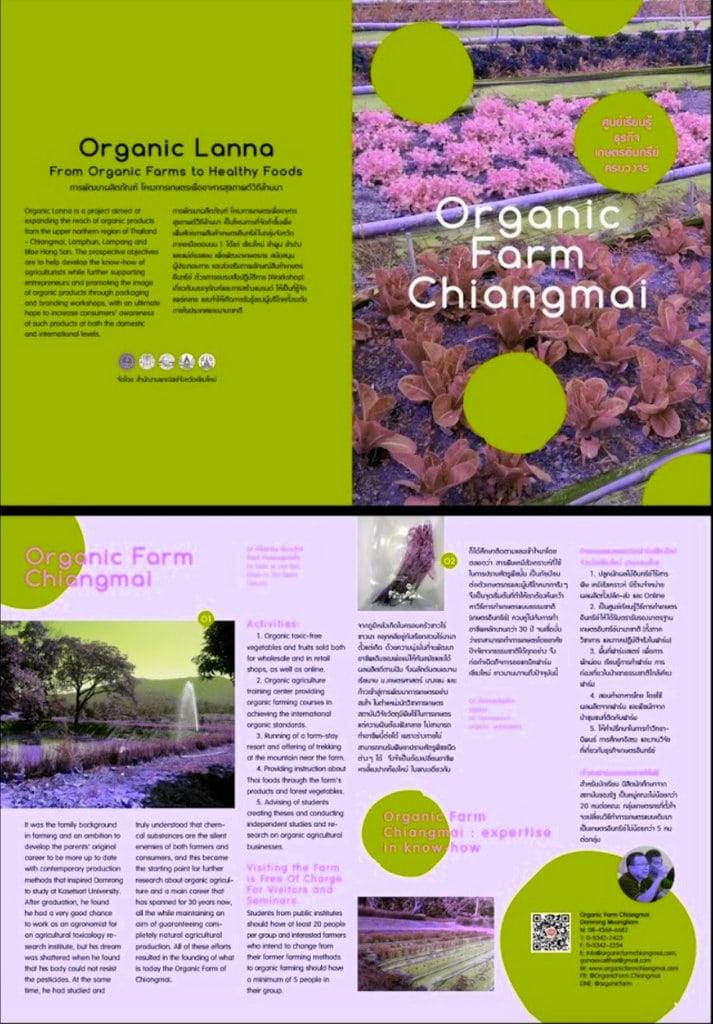
An organic farm in Thailand
Later in the afternoon, we take the scooter and drive in the direction of the San Khamphaeng Hot Springs. On the way there, we visit an organic farm. There are literally only 3 words written in English, and there’s only one man there and he doesn’t speak English. So we can’t get much information our of the visit, but at least we’ve seen it, and it’s the first Thai house that hasn’t got litter strewn all over the place.
The one thing we do understand from the friendly Thai farmer, is that the farm has been made possible by the initiative of the former king Bhumibol Adulyadej. He was much loved by the Thai people and did a lot for them. He even holds several patents!
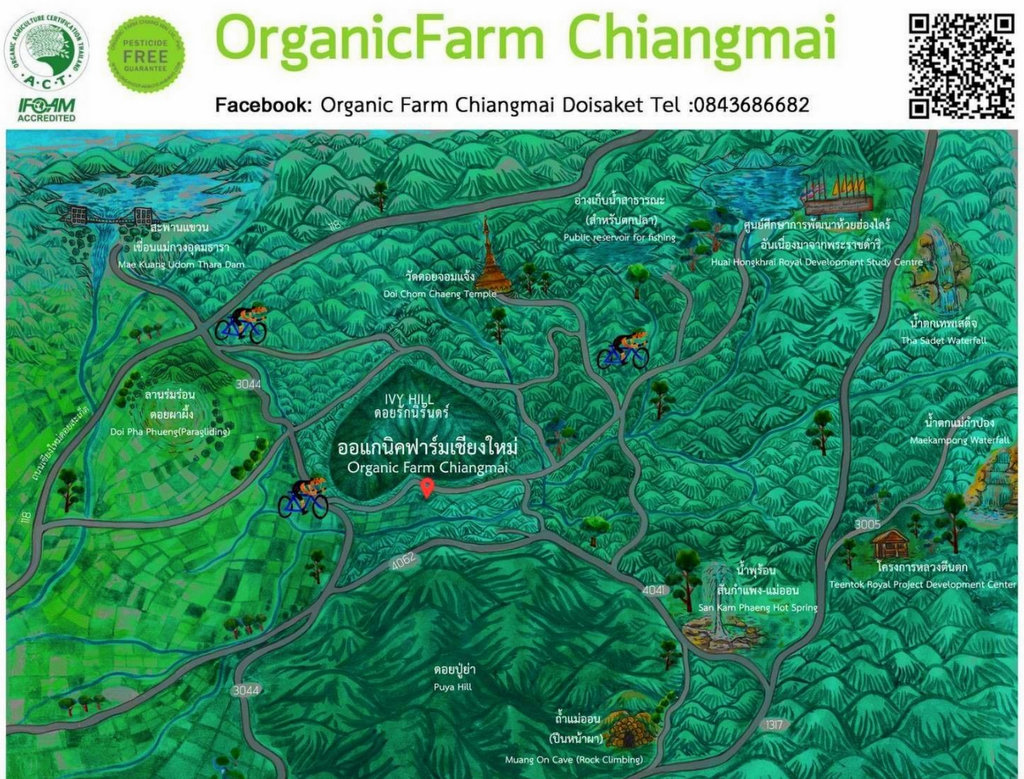

As we continue our way to the hot springs, we pass a road sign indicating another Wat. Since we have no real programme and have fallen in love with Wats, we follow the signs up a narrow road. The road winds up and up. At the end of it, we find Wat Doi Jomjang.

Wat Doi Jomjang
It’s nothing like any of the other Wats we’ve visited so far. Before entering the Wat proper, we discover two cages, each holding a monkey. They are in obvious distress. One of them is continuously moving through the cage, like a polar bear in a zoo. The other one is just sitting in a corner of its cage, looking very sad. The floors of both cages are strewn with litter. Unfortunately, there’s nothing we can do for the poor creatures.
There are cats and dogs everywhere, and there are even puppies running around. One dog is lying in the middle of the road leading into the Wat. As we approach, he gets up and moves away, and that’s when it becomes apparent that his back end is paralysed. He’s dragging his hind legs behind him.
At first, we only see a couple of very young monks. Boys of maybe 12 years old. As we walk up into the Wat, there’s one older monk. And there are some lay people occupying themselves with various jobs. But all in all, there aren’t even ten people.


Thai friendliness
We approach the temple and have a look around. The temple itself is closed. A man on a bicycle arrives. We passed him by on the way up to the Wat. He’s very friendly, though doesn’t speak much English. Hands, feet and smiles play a large role in the communication. As we’re about to leave the Wat, he indicates that we should stay and visit the temple. He says something to the monk, who summons a very young monk.
The boy sprints away and returns with a key. He opens the temple for us and turns the lights on, before leaving us to ourselves in the temple.
It features a big buddha statue and a whole bunch of smaller statues and items. None of it is in very good shape, but it’s obviously held in high esteem and treated with much love.
In total, this Wat is in a very poor state. Everything indicated poverty. We return to the scooter and retrieve a 100 bhat bill, which Christophe donates to one of the donation boxes. I’m sure it’s been a while since anybody visited and donated anything.
The monk notices the gesture and offers Christophe another yarn bracelet, plus one for me. (Monks aren’t allowed to touch women.) These ones are red with 5 white plastic beads. It’s a simple but heartfelt gift that we wear with respect.
What if…
As we leave the Wat, we discuss that, if we were to settle in a region like this, we would like to “adopt” such a Wat and help them. It’s easy for us European to raise money through the internet. And compared to Europe, they need very little to raise their level of welfare. And once that’s done, you can start raising awareness concerning taking better care of animals and the environment.
Also, we would vind a veterinarian to castrate all the cats and dogs. That too is probably much cheaper here than in Europe, and for that too, it wouldn’t be difficult to find European sponsors. Maybe someday, we’ll actually follow through on this plan. Who knows what the future holds for us?
This impromptu visit has made quite an impression on us, and we continue talking about it as we retrace our route back to the larger road. Finally, we reach our original destination: Roong Aroon Hot Springs and Resort.
Roong Aroon Hot Springs
The contrast with the Wat couldn’t have been bigger. Here, everything is proper and clean. The roads are well maintained and the houses are real houses. There are bungalows for guests and there are parks and gardens everywhere.

A bit further into the resort are the hot springs. Heike told us that the water is boiling hot, but they’ve created natural looking baths with warm water you can relax in without burning. We see a big fountain of warm water and two ponds that are steaming in the cooling air.


It’s 17:30h and we’re rapidly running out of daylight. At this hour, the air fills with insects and that’s risky on the scooter. We wear glasses to protect our eyes, but need to be back before it gets really dark. So we head out of the resort and back home.
Bo Sang Umbrella Making Center
The Bo Sang Handicraft village is about nine kilometres east of the Old City and specialises in the paper umbrella-making craft. It was amazing to observe how they make them. There is also a show room where you get many other stuff. If we would live there, we could buy many things…;-)
Umbrellas making in action: